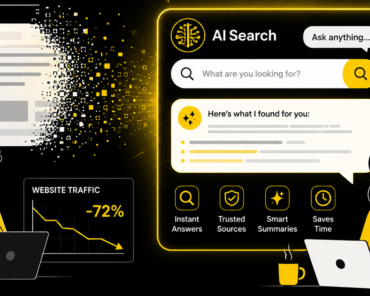
Why This Matters for Your Business Right Now
Search behavior has genuinely changed. A large share of searches today end without a single click, because the answer is already sitting right there on the results page. For informational queries especially — “what is,” “how to,” “best way to” — users are getting satisfied instantly, without ever visiting a website.
For businesses, this creates two possible outcomes:
- You’re invisible. Your competitor gets quoted in the AI answer, your website doesn’t, and the customer books an inquiry with them without ever knowing you exist.
- You’re the trusted source. The AI mentions your brand by name, your positioning as an expert gets reinforced, and even if the user doesn’t click immediately, you’ve planted the seed of trust.
This is especially true for service-based businesses — agencies, educational institutes, consultants, local service providers — where the buyer is doing research before they ever reach out. If an AI tool is the one answering their early questions, you want your business woven into that answer.
How AI Answer Engines Actually Pick Sources
Before you can optimize for something, it helps to understand how the selection actually works. AI answer engines generally favor content that:
- Answers the question immediately. No long-winded introduction before the actual answer — the response comes in the first few lines.
- Is fact-dense, not fluff-dense. Specific numbers, clear definitions, and concrete examples get prioritized over vague marketing language.
- Shows clear authorship and expertise. Content tied to a real author, business, or entity with demonstrated experience is trusted more than anonymous content.
- Is well-structured. Clear headings, short paragraphs, and logical organization make it easy for AI to extract and reuse specific sections.
- Is current. Outdated pages with stale information are far less likely to be selected, especially for time-sensitive topics.
- Is backed by credibility signals across the web. Reviews, mentions on other sites, business listings, and consistent information about your brand all reinforce trust.
Notice that none of this is a “trick.” It’s simply what a helpful, well-organized, trustworthy source looks like — just written for a machine reader as much as a human one.
7 Practical Ways to Get Featured in AI-Generated Answers
1. Answer the question in the first 40–60 words
Whatever question your page is targeting, answer it directly and clearly right after the heading. Save the elaboration, examples, and nuance for after that direct answer. This “answer-first” structure is the single biggest lever for AEO.
2. Structure content around real questions
Instead of guessing keywords, build your content around the actual questions your customers ask. Use question-based subheadings (H2s and H3s) that mirror natural language — “What is AEO?” works better for AI extraction than a vague heading like “Understanding the Basics.”
3. Use structured data (schema markup)
FAQPage, Article, Organization, and Author schema help AI systems understand exactly what your content is about and who’s behind it. Just make sure your schema matches what’s actually visible on the page — mismatched or hidden schema can hurt trust rather than help it.
4. Prioritize your highest-value pages first
You don’t need to rebuild your entire website overnight. Start with pages that carry commercial weight — service pages, comparison pages, pricing pages, and FAQ pages — rather than spending all your effort on general definition content.
5. Keep content fresh and accurate
Set a habit of reviewing and updating your key pages regularly. A page that hasn’t been touched in two years signals staleness to both search engines and AI systems.
6. Build credibility signals beyond your own website
AI engines don’t judge your site in isolation — they look at the wider web. Business directory listings, client reviews, guest mentions, and consistent business information across platforms all add up to stronger trust signals.
7. Keep your site technically healthy
Fast loading speed, mobile responsiveness, clean crawlability, and proper indexing remain non-negotiable. This is still the SEO foundation that everything else is built on — AEO simply doesn’t work without it.
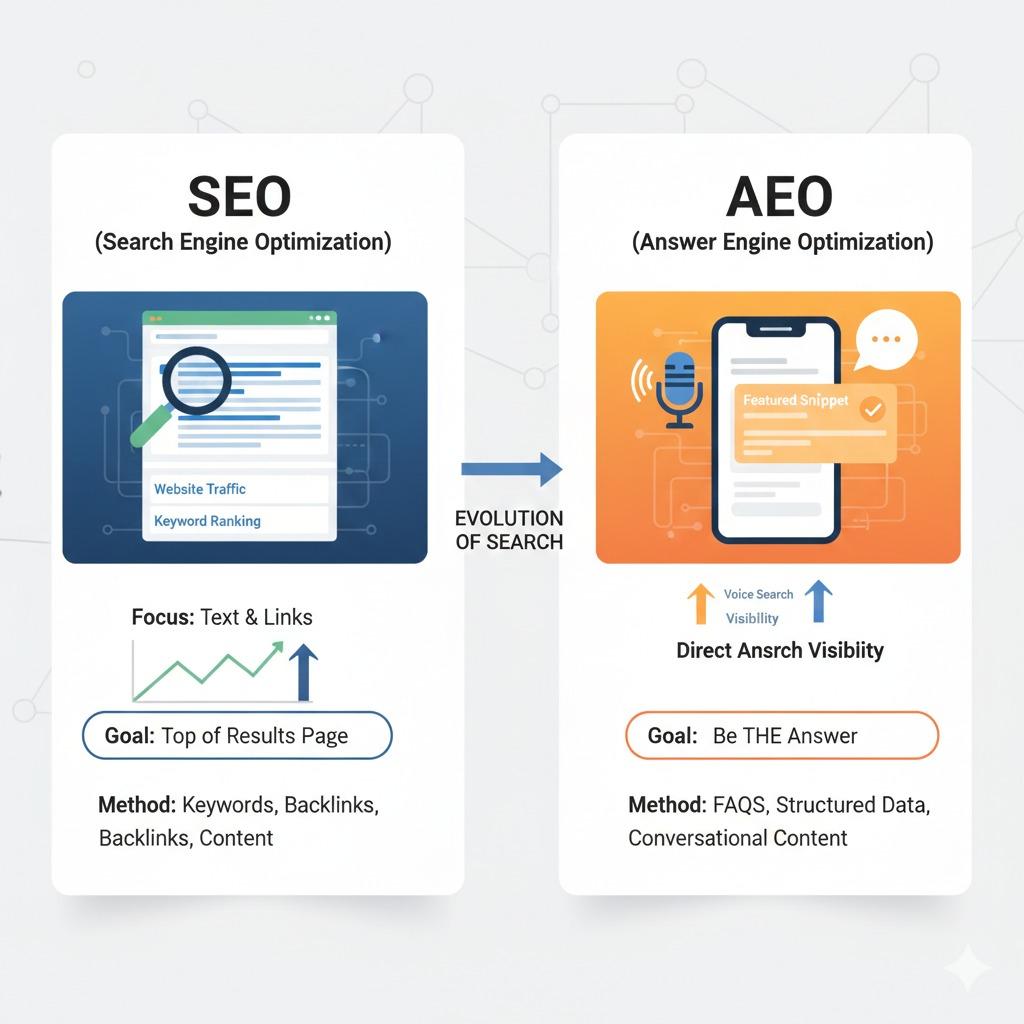
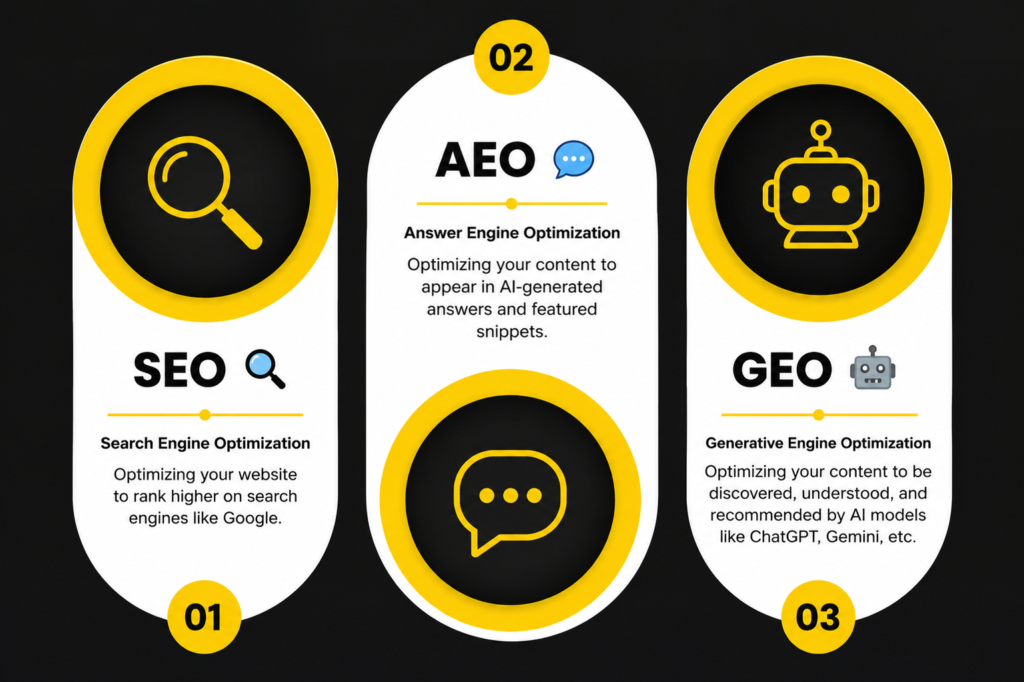
You’ll often see a third term floating around: GEO (Generative Engine Optimization). Here’s the simplest way to think about the three:
- SEO — optimizing to rank in classic search results
- AEO — optimizing to be selected for direct answers, including snippets, voice search, and AI answer boxes
- GEO — optimizing specifically for citations inside generative AI responses like ChatGPT and Perplexity
In practice, these three overlap heavily and share most of their technical groundwork. Most businesses don’t need to treat them as three separate strategies — think of it as one connected system: strong SEO as the base, AEO-style structure layered on top, with an eye toward how generative AI tools specifically summarize and cite your content.
Common Mistakes to Avoid
- Treating AEO as a replacement for SEO. Weak technical SEO means AI can’t find your content in the first place, no matter how well it’s structured.
- Chasing every AI platform separately. You don’t need a different strategy for ChatGPT vs Perplexity vs Google AI Overviews — the fundamentals of clarity, structure, and trust apply across all of them.
- Burying the answer. If your reader (or the AI) has to scroll through three paragraphs of introduction before getting to the point, you’ve already lost the citation.
- Ignoring measurement. Track whether your brand and pages are actually showing up in AI answers. It’s a different kind of tracking than traditional rank tracking, but it’s just as important.
Final Thoughts