Google AI Overviews Are Reshaping Search Results
One of the biggest changes in recent years is the introduction of Google AI Overviews.
Traditionally, Google displayed a list of search results, allowing users to click on different websites to find information.
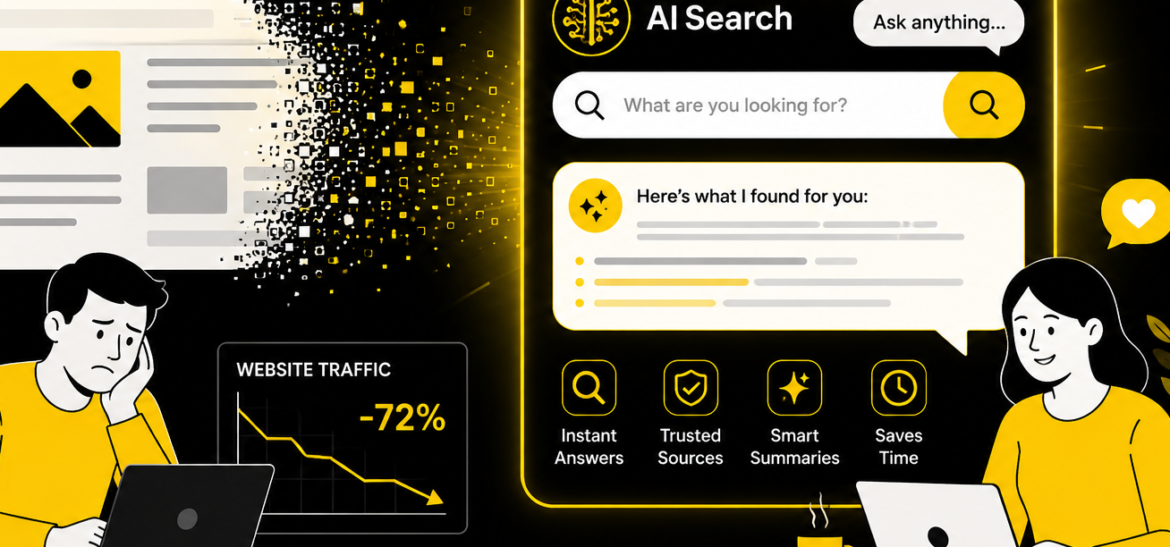
Today, for many informational searches, Google first generates an AI-powered summary that answers the user’s question directly on the search results page.
For example, if someone searches:
- How long does a website redesign take?
- What is AI Search Optimization?
- How does Google Analytics work?
Google may display a detailed AI-generated overview before showing the regular search results.
In many cases, users get the answer they need immediately without visiting any website.
As a result, businesses that previously received thousands of clicks from informational content are now seeing a noticeable decline in traffic.
This doesn’t necessarily mean their rankings have dropped—it simply means fewer users need to click.
AI Tools Are Becoming the First Stop for Research
Search behaviour is evolving beyond traditional search engines.
Instead of opening Google and visiting multiple websites, many users now start their research with AI tools such as ChatGPT and other conversational AI platforms.
Rather than asking several separate questions, users ask one detailed question and receive a complete answer within seconds.
For example, instead of searching:
- Website redesign cost
- Website redesign timeline
- SEO benefits of a new website
- WordPress vs Custom Website
A user may simply ask:
“Compare the cost, timeline, SEO benefits, and best platform for redesigning a small business website.”
AI combines information from multiple sources and presents a clear, structured response.
By the time that person visits Google—or your website—they have already completed much of their research.
They’re no longer looking for basic information.
They’re looking for the right business to work with.
How Search Intent Has Changed
This shift has also changed search intent.
A few years ago, businesses attracted thousands of visitors by publishing articles that answered basic questions.
These informational blog posts served as the first step in the customer’s buying journey.
Today, much of that early-stage research is happening inside AI tools.
When users finally visit a website, they are often much closer to making a decision.
They’re looking for:
- Pricing
- Services
- Portfolio
- Reviews
- Case Studies
- Contact Information
- Free Consultation
In other words, the number of visitors may decrease, but the quality of those visitors can actually improve.
Businesses should focus not only on increasing traffic but also on attracting visitors with stronger purchase intent.
Which Websites Are Most Affected by AI Search?
AI-powered search doesn’t impact every type of website in the same way.
Websites that rely heavily on general informational content are experiencing the biggest decline.
Articles such as:
- What Is SEO?
- Benefits of Digital Marketing
- How Does Google Analytics Work?
- What Is Website Redesign?
are increasingly being answered directly by AI.
On the other hand, websites targeting transactional and local searches remain much more resilient.
Searches like:
- Best Website Development Company in Qatar
- SEO Services Near Me
- Digital Marketing Agency for Small Businesses
- Best Marketing Agency in Qatar
still require users to compare businesses, read reviews, request quotations, or contact a service provider.
AI can recommend businesses, but it cannot replace the decision-making process.
That’s why local businesses and service-based companies still have significant opportunities to generate qualified leads through search.
How can businesses stay visible in the AI era?
The answer isn’t to stop doing SEO—it’s to evolve it.
Today’s successful businesses combine traditional SEO with AI Search Optimization, creating content that works for both search engines and AI-powered platforms.
Here are some strategies that make the biggest difference.
1. Create Original Content That AI Can't Replace
AI can answer basic questions, but it can’t share your real experience.
That’s where your business stands out.
Instead of publishing generic articles, create content based on your own expertise, such as:
- Case studies
- Customer success stories
- Industry insights
- Behind-the-scenes projects
- Practical tips from real experience
Unique content builds trust and is more valuable to both users and AI.
2. Focus on Content That Drives Conversions
Informational blogs are still useful, but don’t overlook pages that help people take action.
These include:
- Service pages
- Pricing pages
- Location pages
- Portfolio
- FAQs
- Customer testimonials
Visitors searching for specific services are often much closer to becoming customers.
3. Build Authority Around Your Expertise
Instead of targeting random keywords, create content around one core topic.
For example, a website development company can cover topics like:
- Website Design
- Technical SEO
- Website Speed
- User Experience (UX)
- Google Analytics
- AI Search Optimization
The more depth you provide, the more likely search engines and AI will recognize your website as a trusted source.
4. Strengthen Your Local SEO
Local searches continue to bring highly qualified leads.
Keep your business visible by:
- Updating your Google Business Profile
- Collecting customer reviews
- Using consistent business information
- Creating location-specific pages
- Adding local keywords naturally
These steps help people find your business when they’re ready to contact a local service provider.
5. Make Your Content Easy for AI to Read
Well-structured content performs better for both users and AI.
Follow these simple practices:
- Use clear headings
- Answer questions directly
- Write short paragraphs
- Use bullet points
- Keep information accurate and up to date
The easier your content is to understand, the more likely it is to be referenced.
6. Build Trust With Real Expertise
Trust matters more than ever.
Show your experience through:
- Client results
- Real examples
- Expert insights
- Industry knowledge
People—and AI—are more likely to trust businesses that educate rather than simply promote.
Common AI Search Optimization Mistakes to Avoid
The Future of SEO
Many businesses ask:
“Will AI replace SEO?”
The answer is No.
SEO is evolving, not disappearing.
Success today is about more than rankings. It’s about building trust, authority, and visibility across Google Search, Google AI Overviews, AI assistants, voice search, and future AI-powered platforms.
Businesses that adapt now will be better prepared for the future of digital marketing.
Conclusion
A drop in website traffic doesn’t always mean your SEO has failed.
More often, it reflects a major shift in how people search for information.
AI-powered search is changing user behaviour, reducing clicks on basic informational content, and rewarding businesses that create original, trustworthy, and experience-driven content.
Instead of seeing AI as a threat, use it as an opportunity to improve your website, strengthen your expertise, and build lasting trust with your audience.
SEO isn’t ending—it’s entering a new era. Businesses that evolve with it will continue to attract qualified customers and grow online.
Ready to Future-Proof Your Website?